|
Andragogy theory
Introduction
One of the big industries that have been effected by the IT technology
Rise in the 20 century is the educational technology, over the past
20 years; educational technology has gone from paper, pencil and a blackboard
to computer presentation software, laser printer, and the World Wide
Web.
This essay provides a comprehensive look at the Andragogy Learning theory,
and its advantages, disadvantages and in using it to produce an online
education technology.
Top Andragogy
theory
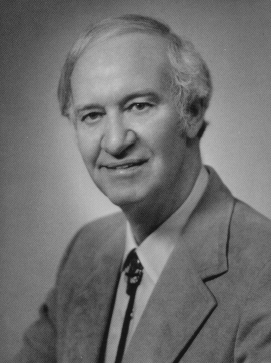 Dr. Malcolm Shepherd
Knowles (1913 - 1997) The soul father of the Andragogy theory. Dr. Malcolm Shepherd
Knowles (1913 - 1997) The soul father of the Andragogy theory.
A German grammar school teacher named Alexander Kapp first used “Andragogy”
or adult learning in 1833, and it comes from two Greek words “Andra”
meaning "adult" and “agogus” Meaning "leading”.
Kapp used it to refer to the education theory of the Greek philosopher,
Plato. Dr. Malcolm Shepherd Knowles (1913 - 1997), professor in adult
learning at Boston University, from 1960 to 1974, and at NC State, from
1974 to 1979. He came along and popularised its usage for English language
readers.
Andragogy was consisting of four elements about the characteristics
of adult learners based at; Knowles added A fifth and sixth elements
later:
1. Self-concept.
Adults are self-directing i.e. once the adult matures; they become more
self-directed human being rather than being a dependent personality
at their teachers. Adults are not like children, children are dependent
upon the teacher for the “what, how, where, and when” the
learning will happen. Adults are able to express what they need from
the learning process therefore that’s why should be a part of
the planning process.
2. Experience.
Adults uses their past knowledge and experiences when it comes to learning
new things, Adult’s experiences tells them that they don’t
need to depend on the teacher in the learning instead they can learn
from each other. They study as a group and learn from each other.
3. Readiness to Learn.
Most adults choose to learn because it’s relevant to what’s
happening in their life; a change in career, aims to keep up socially,
answers to problems that need to be solved, and a desire to know. They
are ready to learn because they see the answer on it.
4. Orientation to Learning.
Adults want to learn by solving problems that they need to apply in
real world problem, not by memorizing content.
5. Motivation to learn.
As a person matures the motivation to learn is internal (Knowles 1984:12).
6. The Learner’s Need to Know.
Adults need to know why they should learn something. Adults used to
understanding things and see if it will benefit them in the long run.
They want to know the reason behind what they learning. An example if
a Spanish class is required to complete a degree, it is wise for the
faculty member to help students understand how what they will learn
will be of use to them in the future.
Difficulties that adults faces adult learners such as:
· Responsibilities such as families, careers, social commitments
· Lack of time
· Lack of money
· Lack of childcare
· Scheduling problems
· Transportation problems
· Insufficient confidence
· Having to learn, if told by boss, but not interested or ready
Top
The Technology
For this coursework our group project is to design a website, with a video
stream to that introduce new students of the London Metropolitan. This
will show them how to log in to the computer facilities, use printers,
use photocopiers and how to use the library facilities.
According to the students records of the London Metropolitan University
55% of its students are aged 24-70, and that’s one of the reasons
I have used Knowles Andragogy theory to support the online training project.
Students come into online courses with different learning
styles, communication skills, motivations, and attitudes. Creating an
online Web site may help new students in using the university facilities.
I work in the university help desk, and I had more than a student who
inserted their student id in the photocopier machine. Our web site may
work as an Instructor who shows these techniques can help students and
become comfortable in using the university facilities.
Advantages of online training courses:
· Reduces overall cost.
· Reduces learning time.
· Consistence delivery of the cotenant.
· On demand delivery.
· Self-pacing.
· Easily updated.
Disadvantages of online training courses:
· Upfront Investment required.
· Software problems.
· Depends on student’s response to succeed.
· Staff may not be happy with it.
Top
Conclusion
To use Andragogy theory while teaching with technology we must use technology
to its Maximum. Advantages for the use of technology are its flexibility
and the ability of the learner to move through it any time, anywhere,
and at their own pace. Also learner may adapt the website material to
cover what they need to learn and eliminate what is not appropriate or
that they have already learned. The technology-based learning must be
used to make its design interactive and learner-centered.
Top Bibliography
lhttp://tip.psychology.org/knowles.html
http://granite.cyg.net/~jblackmo/diglib/styl-a.html
http://www.edtech.vt.edu/edtech/id/ocs/introp2.html
http://www.fau.edu/divdept/found/EDG6255/andragogy.htm
http://www.nl.edu/ace/Resources/Knowles.html
http://www.umuc.edu/distance/odell/ctla/resources_and.html
http://www.mtsu.edu/~itconf/proceed00/fidishun.htm
http://www.infed.org/thinkers/et-knowl.htm
http://www.uni-bamberg.de/ppp/andragogik/andragogy/index.htm
http://www.nwlink.com/~donclark/hrd/history/andragogy.html
http://www.gmp1st.com/trtp/trtp0101.htm
http://instructordiploma.com/core/102%20B/victoria/mynen.htm
http://campus.skillnet.ca/course_demos/Learn/main_page/toc.htm
http://www.mtsu.edu/~itconf/00/four.html
Top |